
 Back to Work
Finodus
An independent reconciliation prototype for verifying evidence, controlling agent permissions, and reviewing financial decisions.


The full story5 min read
What is this?
A four-day independent interaction-design project, implemented with Codex. I designed how an accountant verifies evidence, controls changes, and submits work for independent review.
Evidence status: working interaction prototype with synthetic records. Primary user research and business outcomes remain unvalidated. No time saving or reduction in month-end close duration has been measured.
Why I chose this problem
Provisional roles: a Senior General Ledger Accountant prepares USD cash reconciliations at a lean US mid-market company; a Controller owns policy and reviews. Responsibilities and problem severity need interview validation.
Job to support: resolve uncertain payments and submit a defensible reconciliation without repeatedly assembling the same evidence across systems.
Secondary research raised a design question: how should people oversee agents that can initiate reconciliation actions? Vendor offerings and finance AI research informed this exploration, not target-user demand. BlackLine announcement, KPMG survey
I chose a bounded scenario before primary research. It makes interactions testable without validating the problem or a production investment. Next, I need to establish whether evidence gathering is a meaningful bottleneck for these users.
An illustrative model, not an outcome
| Unvalidated inputs for one team | Hypothetical baseline | Hypothetical alternative |
|---|---|---|
| Exceptions handled each month | 100 | 100 |
| Active handling time per exception | 8 minutes | 5 minutes |
| Monthly handling time | 13.3 hours | 8.3 hours |
No productivity gain has been observed. 100 × (8 − 5) ÷ 60 = 5 hours/month, a 37.5% difference in assumed handling time. Volume, baseline, and alternative time are invented planning inputs, not measurements, benchmarks, or a forecast.
Handling effort is different from elapsed close duration. Other tasks, dependencies, approvals, errors, and rework remain unmeasured; integration and operating costs are excluded. This model cannot establish a shorter close.
One withdrawal made the trust problem concrete
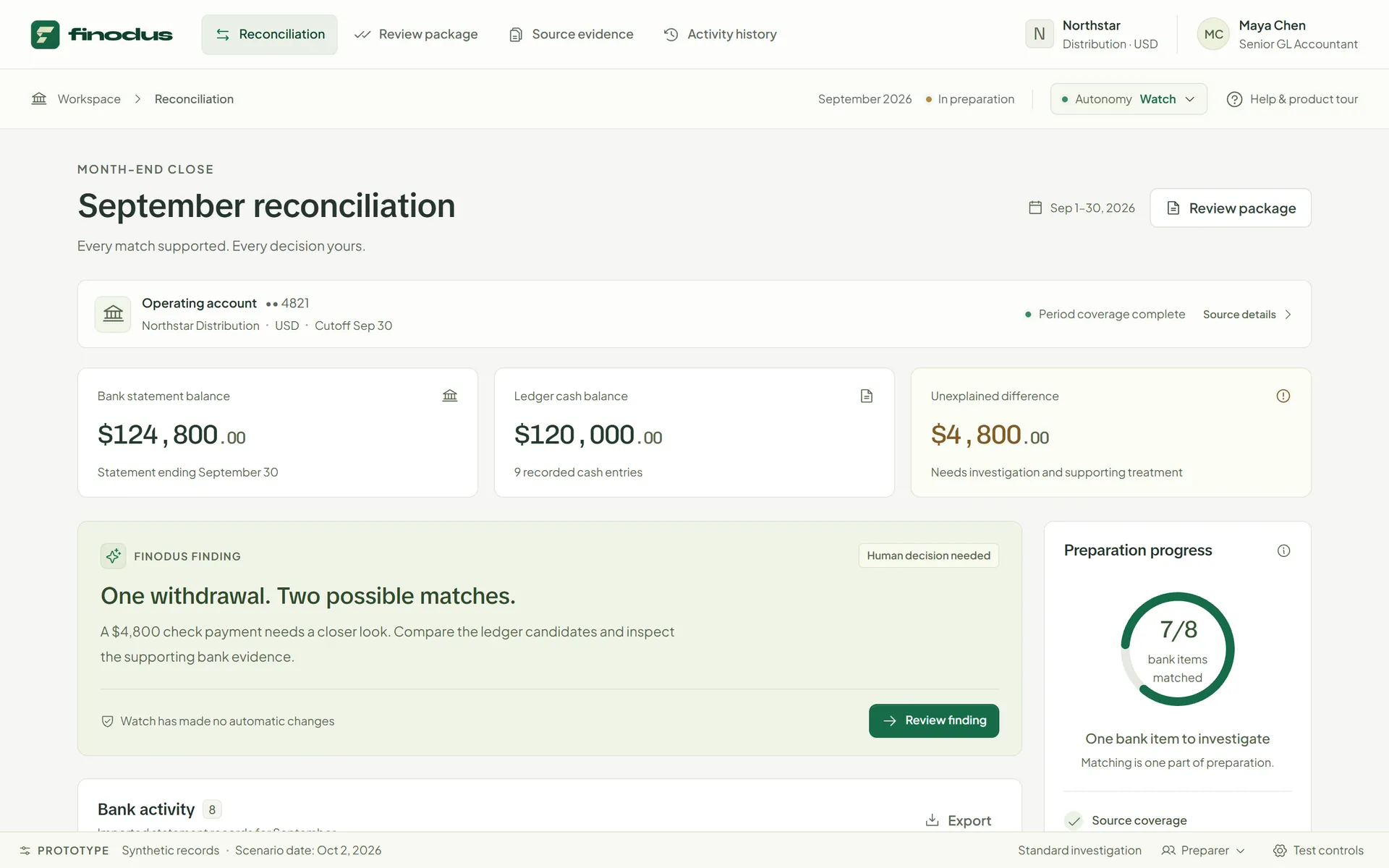
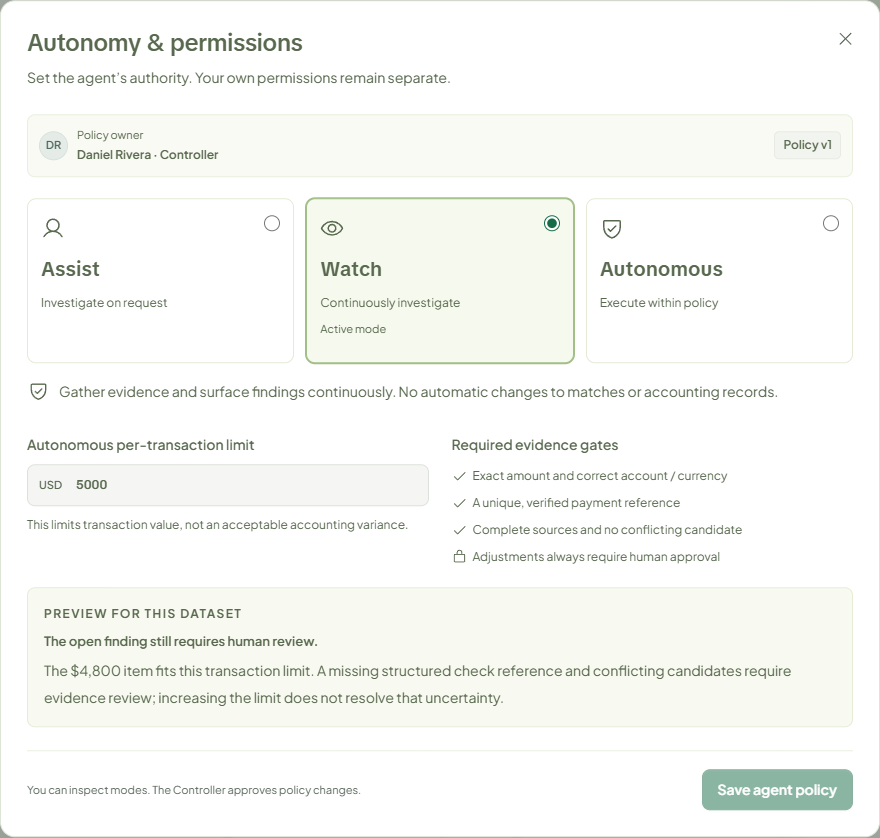
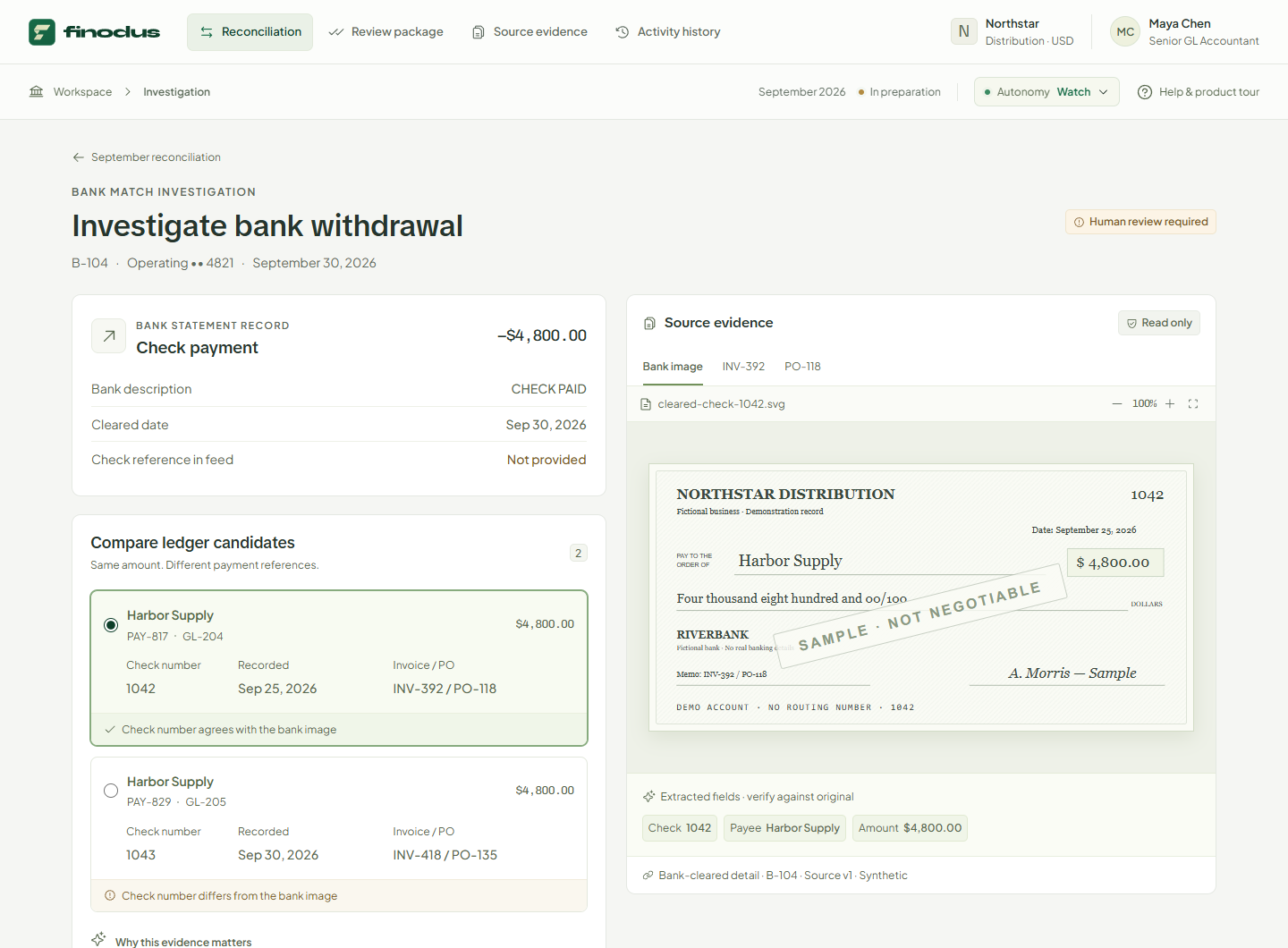
At September 30, two legitimate Harbor Supply payments are each $4,800. The bank feed lacks a reference. Choosing the nearest date could mark the wrong payment as cleared.
flowchart TD
    B["Bank withdrawal B-104<br/>$4,800 · reference missing"] --> C["Two plausible ledger payments"]
    C --> P1["PAY-817 · check 1042"]
    C --> P2["PAY-829 · check 1043"]
    E["Original bank image<br/>identifies check 1042"] --> P1
    P1 --> M["Human confirms match<br/>Cash balances unchanged"]
    M --> O["Document check 1043 as outstanding<br/>using issue record and complete cutoff data"]
    P2 --> O
    O --> R["Submit evidence package<br/>Controller reviews independently"]
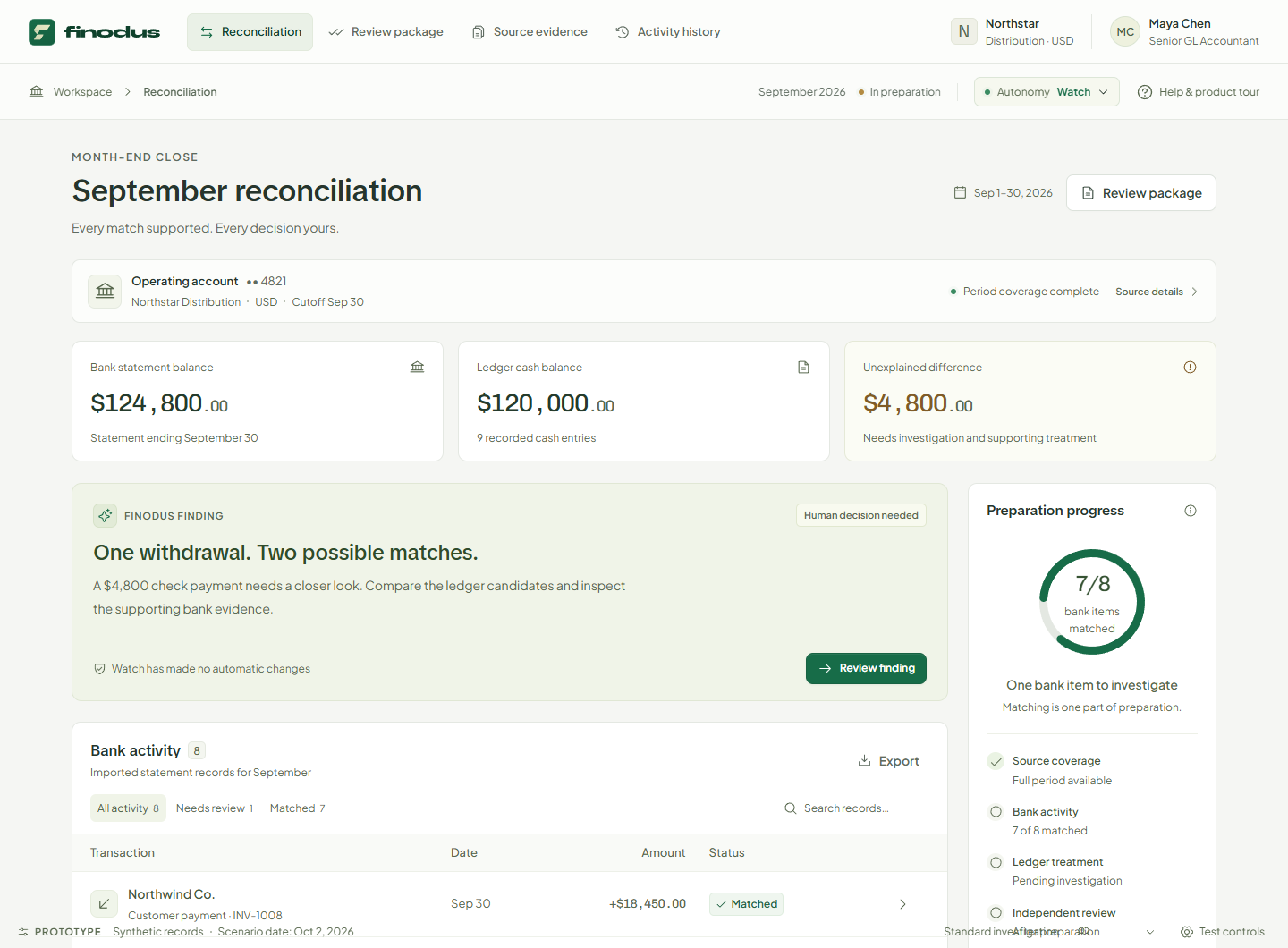
My most important design decision: separate permission from evidence sufficiency. The $4,800 payment is below the $5,000 example cap, but ambiguity still requires review. I accepted extra review work so a low amount could not substitute for verification. The evidence requirements and action consequences were design decisions implemented through AI-assisted code.
| Agent mode | Permission contract |
|---|---|
| Assist | Investigate on request; a person confirms matches. |
| Watch | Investigate continuously; make no automatic record changes. |
| Autonomous | Record only policy-eligible matches; escalate evidence conflicts. |
These are intended permission contracts. This fixture demonstrates the human review hold; it does not implement or evaluate a general autonomous matching service.
Turn evidence into a reviewable decision
I set and reviewed the scope, permission contracts, evidence hierarchy, state rules, and acceptance conditions. Codex helped develop and implement them. Coding directly from the task flow made recovery testable; the information architecture remains provisional.
1. Explain the recommendation where the decision happens
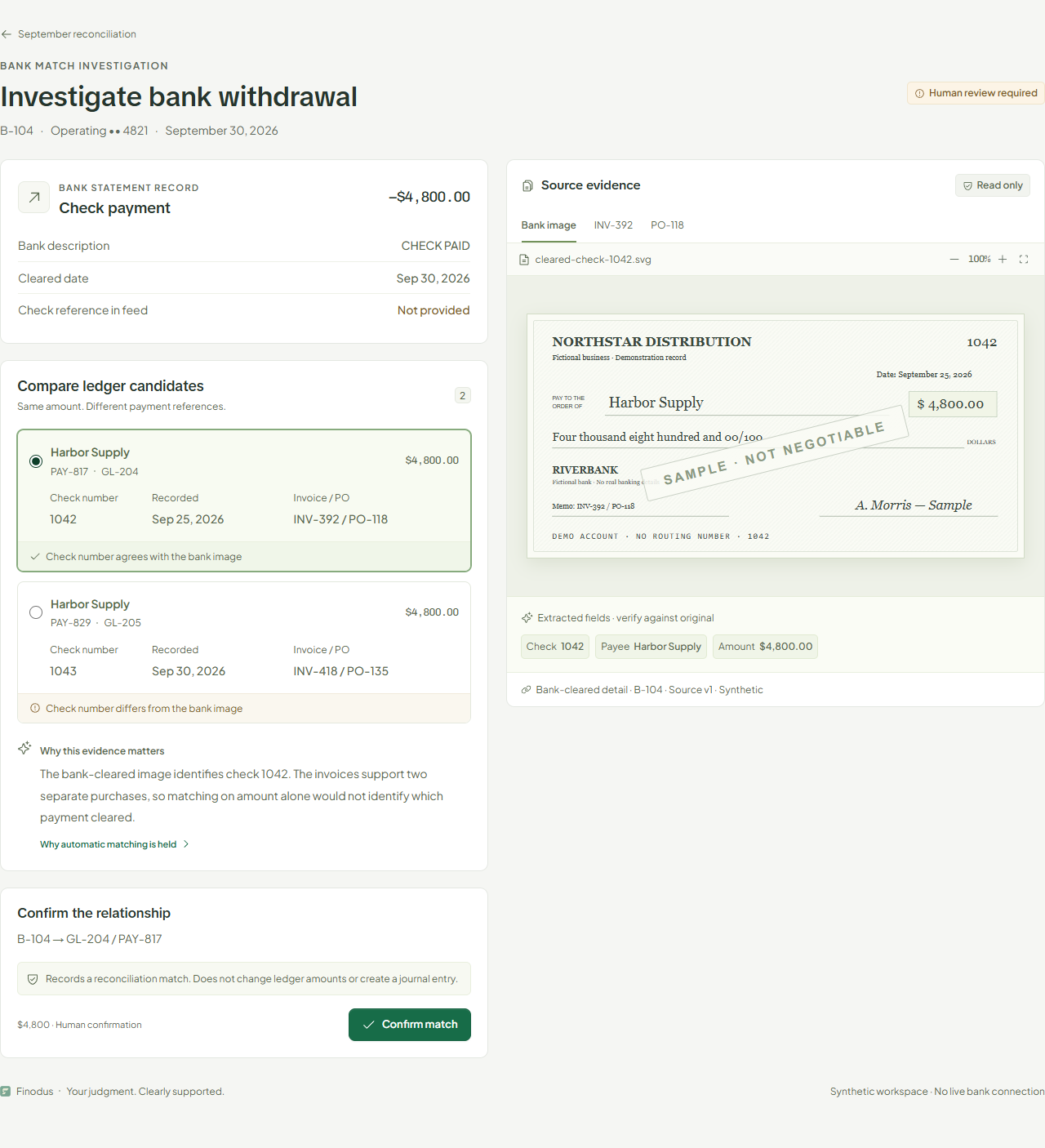
- Compare both candidates beside the original image and extracted fields.
- Trace the choice through B-104 → check 1042 → PAY-817 / GL-204 → invoice → PO.
- Preview the exact relationship before saving; explain that cash balances stay unchanged.
I chose inspectable evidence over an unexplained confidence score. Invoices support the purchase; the bank image identifies clearance.
The supplied candidates, image, and extraction are scripted. Correct selection in this fixture cannot demonstrate AI matching or extraction accuracy.
2. Explain why the agent stops
flowchart LR
    W["Watch mode"] --> H["Human confirmation required"]
    A["Autonomous mode"] --> G{"Limit and evidence<br/>requirements satisfied?"}
    G -->|No| H
G -->|Yes| X["Eligible automatic match<br/>Product direction beyond this fixture"]| Moment of doubt | Interface response | Intended business benefit |
|---|---|---|
| Has everything arrived? | Cutoff coverage and source versions; block incomplete preparation. | Avoid premature submission. |
| Why this payment? | Alternatives, original evidence, and specific matching fields. | Reduce repeated evidence gathering. |
| Did my action save? | Pending, failed, and uncertain results; check status before retrying. | Avoid duplicate actions and rework. |
| Can I correct it? | Unmatch with a reason; retain earlier actions and package versions. | Make review and recovery reconstructable. |
Unresolved risk: users may misread Watch. Current finding/policy copy explains the restriction; the short mode label is untested. I would evaluate “Watch — investigates only; changes need your confirmation,” with actor and action scope at confirmation. This proposed revision needs testing. Copy must describe enforced behavior, not replace permission checks.
3. Separate a recorded match from a completed reconciliation
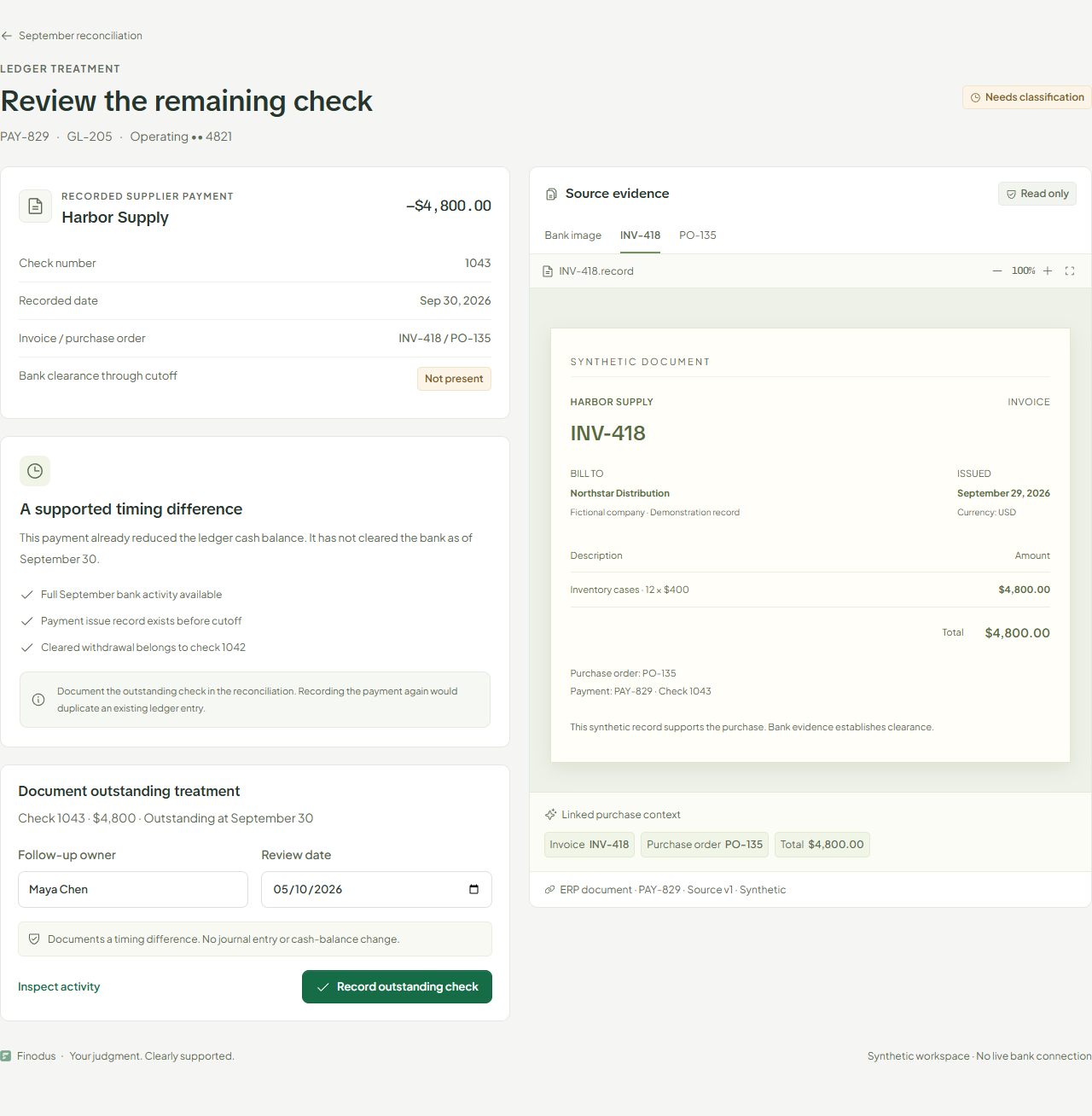
Check 1043 already reduced the books. Outstanding treatment explains timing; recording another payment would duplicate it. Accounting basis: OpenStax
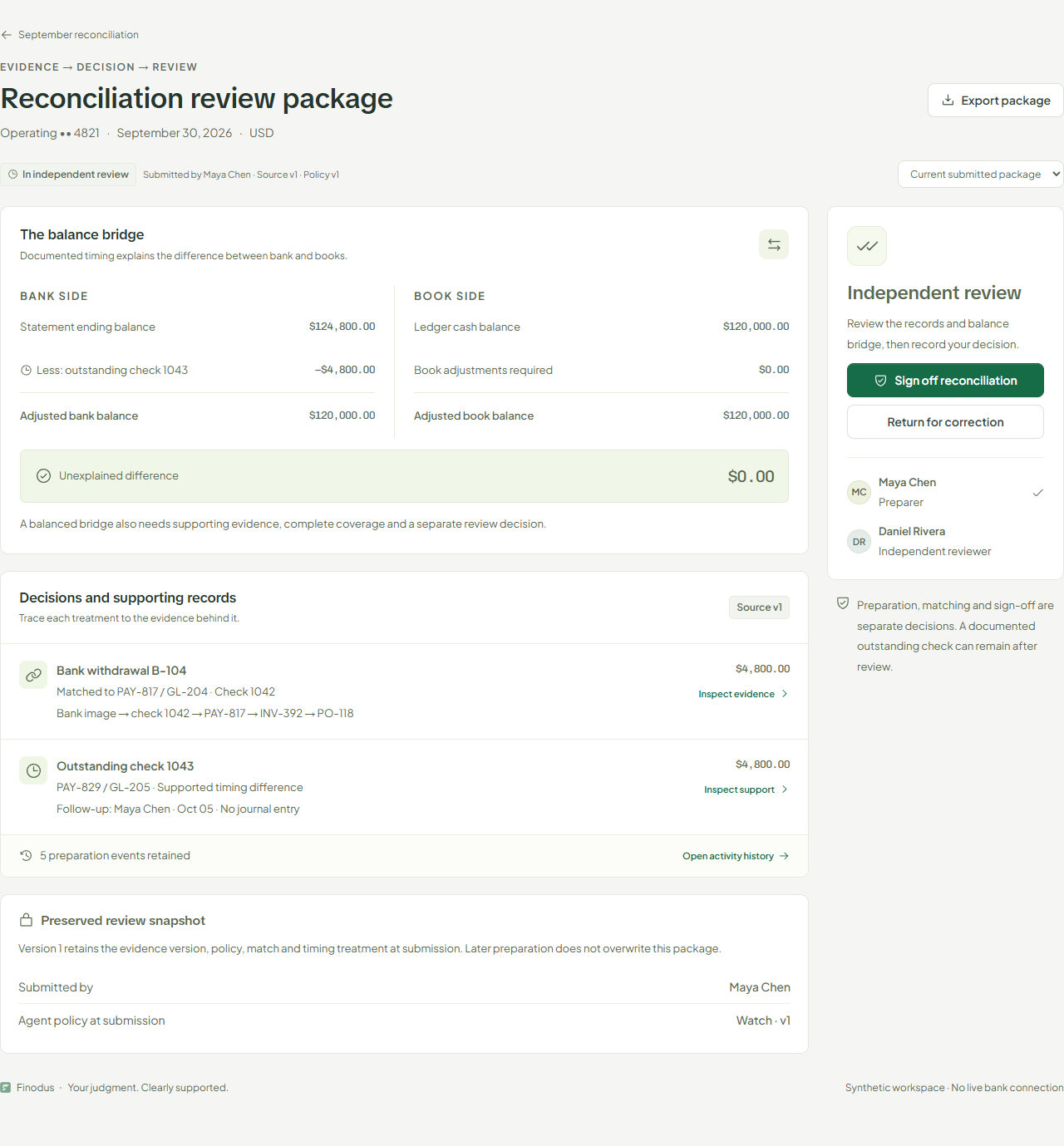
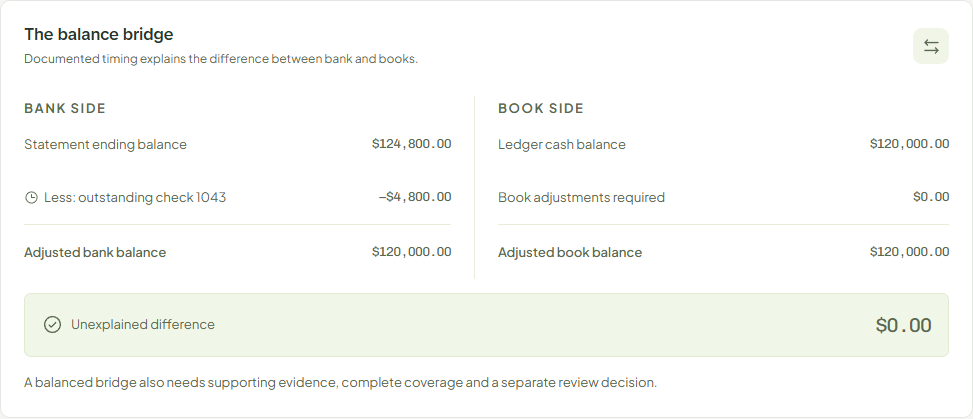
$124,800 bank balance − $4,800 outstanding check = $120,000 book balance. The unexplained difference becomes zero; the outstanding check and its follow-up remain visible.
stateDiagram-v2
    [*] --> Preparation
    Preparation --> Review: Preparer submits supported package
    Review --> SignedOff: Controller signs off
    Review --> Returned: Controller records correction reason
    Returned --> Review: Preparer revises and submits a new version
    SignedOff --> Preparation: Controller reopens with a reason
    note right of Review
        Submitted evidence and decisions
        remain preserved as a snapshot
    end note
What the working prototype actually demonstrates
- Working interactions: candidate comparison, explicit confirmation, outstanding-check treatment, submission, return/reopen, and a replayable tour.
- Deterministic state rules: fixture-specific evidence and role checks, safe retries, and retained review snapshots, persisted in the browser.
- Design implementation: Figma for palette, brand, and preliminary dashboard exploration; React/TypeScript/Vite, Bklit, Phosphor, responsive hierarchy, and reduced-motion support.
- Engineering checks: 15 unit and 10 scripted browser checks cover the implemented paths. They do not establish user comprehension, productivity, model accuracy, production security, or complete accessibility conformance.
AI findings, source retrieval, save outcomes, and identities are simulated. The role switch is a research control, not authentication; local snapshots are not tamper-proof audit storage. There is no live model, bank/ERP connection, or shared backend. Explore the source on GitHub.
Validate understanding before expanding autonomy
What I learned through design and implementation
- Permissions, evidence, saves, and review need separate states; one “done” indicator would conceal unfinished work.
- Watch makes investigation value testable before granting execution authority. Its usefulness remains unvalidated.
- Recovery belongs in the initial experience to expose misunderstanding of uncertainty and corrections.
Future plan: establish the need, then evaluate the interaction
First, walk through recent closes with accountants and Controllers: establish volume, sources, responsibilities, handling time, and delays. Revise the scope if the assumed bottleneck is not material. Then run the formative round:
| Plan | What I will observe |
|---|---|
| Recruit 4 preparing accountants and 2 Controllers; 45–60 minutes each. | Recent reconciliation experience and actual responsibilities. |
| Ask what Watch will do before any financial action; record tour exposure. | Whether users distinguish investigation, manual confirmation, and autonomous execution. |
| Preparers resolve September’s finding and prepare submission; do not name the correct check. | Source-based explanation, timing interpretation, assistance, and perceived control. Correct selection alone is insufficient because the fixture supplies explanatory hints. |
| Controllers inspect a submitted package, then practice returning it. | Decision reconstruction, review boundaries, and actionable feedback. |
| Counterbalance missing-evidence / mistaken-match fixtures for preparers. | Recognition, recovery, and retained history. |
Revision gates: all 6 distinguish Watch investigation from financial writes; all 4 preparers justify the supported payment using the source; both Controllers explain the bridge and review status. Any authority/accounting misconception triggers revision and retesting. Small-sample gates are not population success rates or evidence that autonomous operation is safe.
Prototype task timing can reveal interaction friction. A later operational pilot with real source retrieval, representative cases, and comparable current workflows would be needed to estimate productivity, including review, failures, and rework. A separate end-to-end baseline would be needed to assess overall close duration.
Back to selected workAll screenshots show actual prototype states with synthetic data. The completed outcome of this project is a testable interaction and control model; business impact remains a research question.
The overview60 sec read
Independent four-day concept. Working front-end prototype; synthetic records, simulated AI/integrations/identities, and no completed user validation or measured business impact.
The problem
Two legitimate $4,800 payments; one bank withdrawal without a reference. Secondary research informed this scenario; user need and role assumptions remain unvalidated.
What I designed and built
Key decision: a low transaction amount cannot override conflicting evidence. Watch investigates; a person explicitly confirms changes.
flowchart LR
    A["Inspect source"] --> B["Confirm supported match"]
    B --> C["Document outstanding check"]
C --> D["Independent review"]I owned the workflow and permission rules. Figma supported branding and early dashboard exploration; Codex supported a React/TypeScript implementation with browser-local state, corrections, and review snapshots.
Evidence and next steps
No time saving measured. The five-hour figure is illustrative arithmetic: 100 × (8 − 5 minutes) ÷ 60. Every input is assumed; it predicts neither likely savings nor close duration.
Next: recent-close interviews; six formative sessions testing Watch comprehension, evidence use, review, and recovery; then an operational pilot for productivity. Misunderstanding Watch’s authority triggers revision and retesting.
Back to selected work